

School: The Archer School for Girls
Teacher: Helen Reese
This picture was taken at the front of our school on a bright spring day. The sunlight streamed through the double convex lens, inverting the image. As rays of light hit the lens, they are refracted, causing what we see as the top of the maypole to appear as the bottom, thus creating this fun illusion

School: Northfield High School
Teacher: Rebecca Messer
This image is a composite of ten photos shot at four frames per second by a tripod-mounted remote-activated camera at a lake near my cabin in Wisconsin. The image shows the photographer riding a rope swing from its maximum displacement on the right to the left. In this way, the photographer and the rope swing demonstrate part of the period of a simple pendulum. In simple pendulums, a mass is suspended by some length of material from a pivot point, is displaced, and is allowed to swing freely. In this case, the mass is the photographer (myself), the material is rope, and the pivot point was a tree branch of questionable stability

School: West Boca Raton High School
Teacher: Maria Aparicio
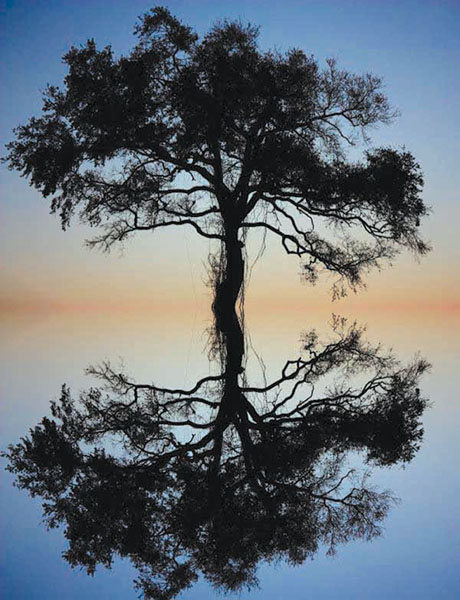
The double image you are looking at is the reflection of a single tree over a lake in Florida during sunset hours. I was standing on the side of the lake, with the tree in front of me and I zoomed in on the tree and it's reflection so no other objects were in the picture. The sun is setting which helps create a reflection in the lake. The lake acts as a plane mirror and creates an image that is the same size, virtual, upright and reversed. The law of reflection states that when an object bounces off of a flat surface, the angle at which it hits the surface will be equal to the angle at which it bounces away, hence why the image is so exact that it appears to be the continuation of the branch.
School: Viewpoint School
Teacher: Mrs. Nancy Argano-Rush
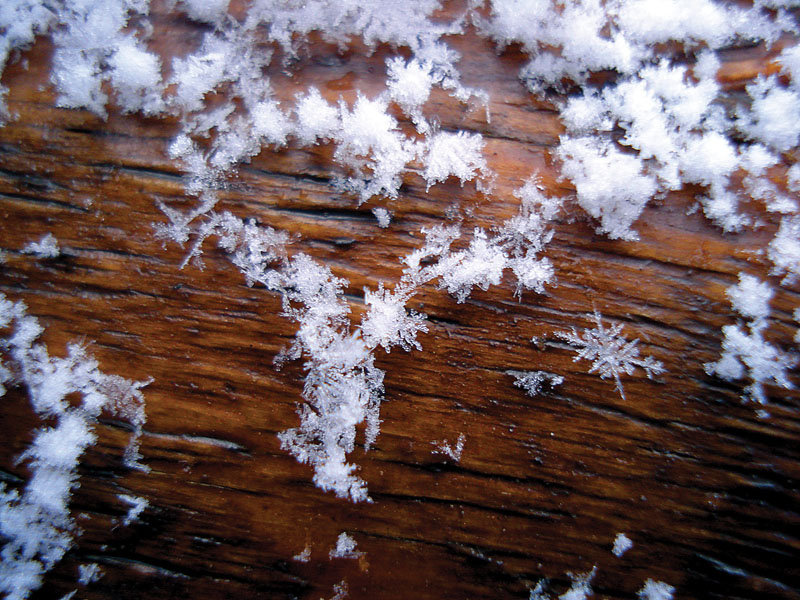
Snowflakes form when water vapor condenses on a dust particle or sulfuric acid. The water vapor must condense directly into ice, which happens in snow clouds. Clouds also cause the water vapor to diffuse into the air and travel more slowly to the dust particle or sulfuric acid, allowing it to grow gradually with each molecule of water vapor and not with one big drop of water. As the water condenses into ice it forms hexagonal prisms. Along uneven surfaces or edges more water vapor condenses into ice causing branches to form around the hexagonal prism on the imperfections in the first molecule. These bumps then become even better places for water vapor to condense into ice causing the branches to grow and branch off. Snowflakes have many different shapes due to the different temperatures at which the water vapor condenses into ice.
School: Fox Chapel Area High School
Teacher: Dan Malone
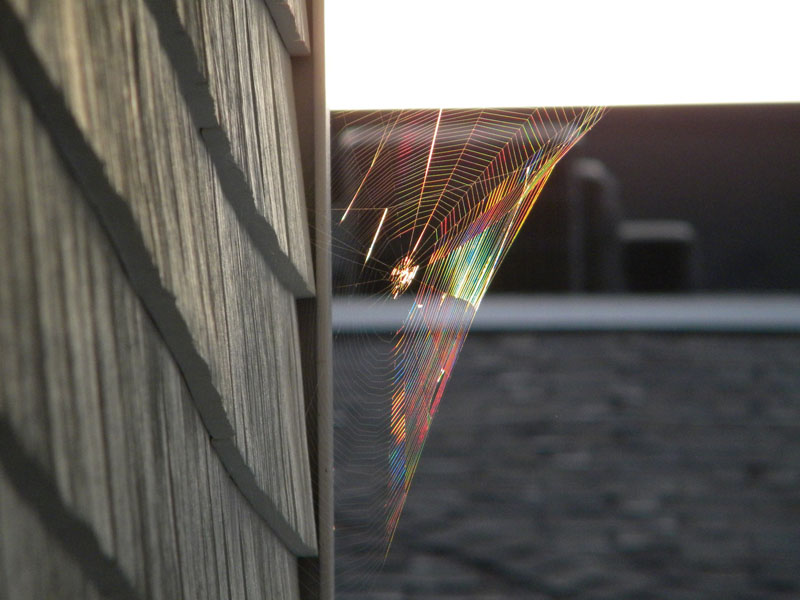
Rainbows are an amazing site to behold yet one may not realize that the laws that apply to them also apply to so many other things around us. We can see the laws play out in some of the most unusual places, in this case, a spider web. This picture was taken at the time of sunrise when the web has a layer of dew covering it. When the light passes into a medium at an angle, the light beam is bent or refracted according to Snell's Law, which is a formula that describes the relationship between the angle of incidence and refraction. Light of higher frequency is refracted less than that of a lower frequency. Thus, each wavelength is refracted at a slightly different angle when passing through a medium. Another factor that plays into this natural phenomenon is the speed of the waves. The wave theory states that light is refracted because its wave also changes speed as they pass through a substance. This theory assumes that the speed of light waves is decreased on entering the substance. As each part of the wave enters the dew it slows down and causes the refraction. Since the sunlight we see is made up of waves of all colors, they are all projected into different angles. This in turn causes us to see the colors that we do on the cobweb.
موضوعات مرتبط: عکس ، جشنواره ، کنفرانس ،مسابقه ، المپیاد